Thursday, December 12, 2024

Work Cited

Work Cited Page 
  •  Ladd, Helen F. “Teacher Labor Markets in Developed Countries.” The Future of Children, vol. 17, no. 1, Spring 2007, pp. 201-217.
  • Poliakoff, Michael. “The Path to Teacher Quality from Regulation to Local Responsibility.” Spectrum: The Journal of State Government, Summer 2002, pp. 5-6.
  • National Education Association (NEA). “Teachers’ Salaries.” NEA Report, 1951, pp. 189-196.
  • Smith, Robert, Scott Imig, and Kayce Smith. “Standing for Public Education.” Change Magazine, September/October 2019, pp. 7-11.


Blog Five: The Future of Education

    The Future of Education: An Urgent Appeal for Innovation
Technology in Education ...

Ms. Patel is sitting at her desk in the year 2040, marking essays from her fourth-grade students. Compared to the difficulties experienced by educators decades ago, teaching is now one of the most prestigious and lucrative occupations. The change wasn't simple. The profession was beset by high attrition rates and stagnating compensation in the 2020s. But reforms motivated by research altered the course. Helen F. Ladd promoted differentiated compensation as a solution to the shortages in high-need courses. Teachers were given a say in policymaking thanks to teacher-led activism, which was sparked by Robert Smith and his associates. Additionally, Michael Poliakoff's backing of flexible compensation plans brought in a fresh group of bright individuals. The result of their efforts is reflected in Ms. Patel's tale. She gains from competitive compensation, chances for professional growth, and an innovative school atmosphere. Her kids flourish in an atmosphere that encourages creativity and critical thinking, and her classroom is furnished with state-of-the-art materials.Teaching has a promising future, but it will need ongoing support and funding. The accomplishment of Ms. Patel serves as a reminder that the foundation of a successful educational system is the appreciation of teachers.
AI and Education: A Dynamic Duo ...


Blog Four: Active Advocacy

"Active Advocacy: Teachers Taking the Lead"

Pin for Sale by CitizenAwear | Redbubble

 Thanks to Ms. Walker, a history teacher at a North Carolina middle school, the hashtag #StandForTeachers was trending on social media. She took action after becoming frustrated with new salary regulations that further constricted pay ranges. Ms. Walker started a grassroots effort to elevate teachers' voices after being inspired by studies conducted by Robert Smith, Scott Imig, and Kayce Smith. She shared first-hand accounts from educators around the state, coordinated a demonstration, and collected petition signatures. As her movement grew, state lawmakers and even the local media took notice. What makes a teacher stand out from othersThe influence of teacher-led efforts in influencing educational policy is demonstrated by Ms. Walker's campaigning. Her efforts highlighted the significance of providing teachers with a place at the table, even when systemic change is gradual. Smith and his colleagues contend that advocacy is about actively creating a better future for both educators and kids, not merely responding to regulations. Ms. Walker's campaign served as a reminder to her classmates that their opinions count. Together, they started a dialogue that is still pushing for significant change in the field they are passionate about.

Blog Three: Reevaluating Teacher Salary


Reevaluating Teacher Salary: A Principal's Views on Reform

Teaching Needs More Than Pay Hikes - FutureEd

     Adrian Garcia, the principal, spoke steadily yet passionately as he gazed out at the school board members. He stated that "we need to rethink how we pay them if we want to recruit and retain the best teachers." Three main techniques were included in Principal Garcia's proposal: a merit-based system to recognize great performance; signing incentives for teachers in underprivileged regions; and differential compensation for high-demand disciplines like science and math. He cited Michael Poliakoff's research, which shows how effective these tactics are in luring and keeping great personnel.However, there is always opposition to change. Some educators were concerned that merit-based compensation may prioritize test scores above the complex work they conduct in the classroom. Others were concerned that staff divides would result from differing remuneration. While acknowledging these worries, Principal Garcia underlined how urgent it is to overcome the teacher shortage and guarantee that pupils get high-quality instruction.His idea is an essential departure from the one-size-fits-all approach to pay. Schools may establish an atmosphere that draws and keeps talent while encouraging professional development by appreciating teachers as individuals and acknowledging their distinctive contributions.Don't Raise Teacher Pay; Reform It | American Enterprise Institute - AEI

Blog Two: The Price of Caring

 The Price of Caring: The Reasons Teachers Quit Teaching

            Why Teachers Quit | The Marquette Educator


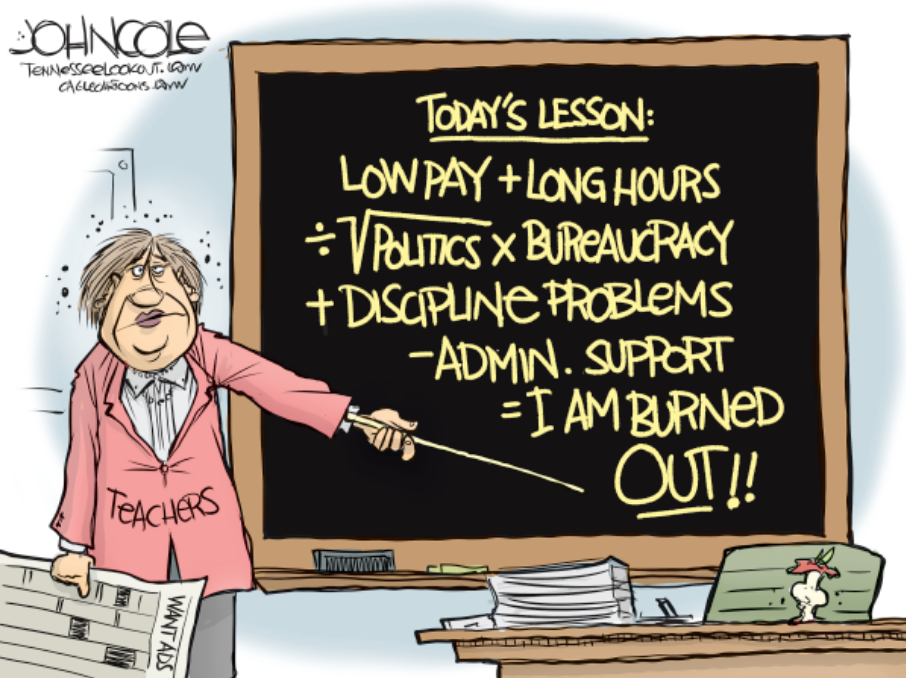
        As she packed away her desk, Sarah groaned, "It's not worth it anymore." Her close friend and coworker, Mark, looked on silently. Sarah had decided to quit teaching after years of dealing with poor salary, packed classrooms, and never-ending administrative work.
Many instructors may relate to Sarah's tale. According to Helen F. Ladd's study, there is a severe teacher shortage in fields like science and math where pay is not competitive with the private sector. The issue is significantly more severe in rural and urban regions. The problem is made worse by uniform pay scales that ignore subject-specific demand and the cost of living. The Big Read: What can make our teachers happier and less overworked?  Here's looking at you, parents - CNASarah's departure was a huge loss for her kids and the school community, but Mark chose to stay in the hopes that things would change. Sarah and other teachers quit because the profession doesn't care enough about them, not because they don't care.Students, schools, and communities are all impacted when enthusiastic teachers like Sarah die away. Band-aid fixes are insufficient to address this situation. It demands a systematic shift in how we assist and appreciate the people who will determine our future.

Blog One: The Battle for Wages

 The Battle for Wages: A Teachers Perspective 
Why Teachers Will Go on Strike - The Santa Barbara Independent

        Ms. Eleanor Reed, a third-grade teacher in a small Midwestern town, is sitting at her kitchen table in 1951, looking through a pile of bills. Her paycheck barely covers the necessities, and with growing expenses, even groceries have become difficult to afford. Despite her commitment to her students, the financial strain makes her wonder if she can continue to teach. According to a 1951 NEA report, Ms. Reed's struggle was not unique. While wages in other professions increased after World War II, teacher salaries fell behind, losing a significant amount of purchasing power. The average teacher salary in 1951 was $3,095 annually, but it had not kept up with inflation, leaving teachers with families stretched thin and unable to achieve financial security.The narrative of Ms. Reed seems all too familiar as we go forward to 2024. Teachers nowadays frequently deal with same financial difficulties, as their pay does not adequately compensate them for their duies. Florida Teachers Take To The Capitol For More Education Funding, Pay Hikes  | WUSFTeachers put in a lot of overtime and frequently pay for classroom materials out of their own pockets while their compensation stays the same. The profession itself is in danger of being undermined by the ongoing undervaluation of teachers. Despite being a work of fiction, Ms. Reed's narrative depicts a reality that has persisted for decades. In light of her hardships, we need to consider how we can guarantee that teachers now and in the future are appreciated, supported, and appropriately rewarded.  


Work Cited

Work Cited Page    Ladd, Helen F. “Teacher Labor Markets in Developed Countries.” The Future of Children , vol. 17, no. 1, Spring 2007, pp. ...